How to Travel to Russia for a Mountain Trip: Visas, Flights, Money and Connectivity
Planning a climb or trek in Russia? Here is a practical overview of visas, flight routes, payments, mobile data and safety — and what we take care of for you.
7 min read

In this article
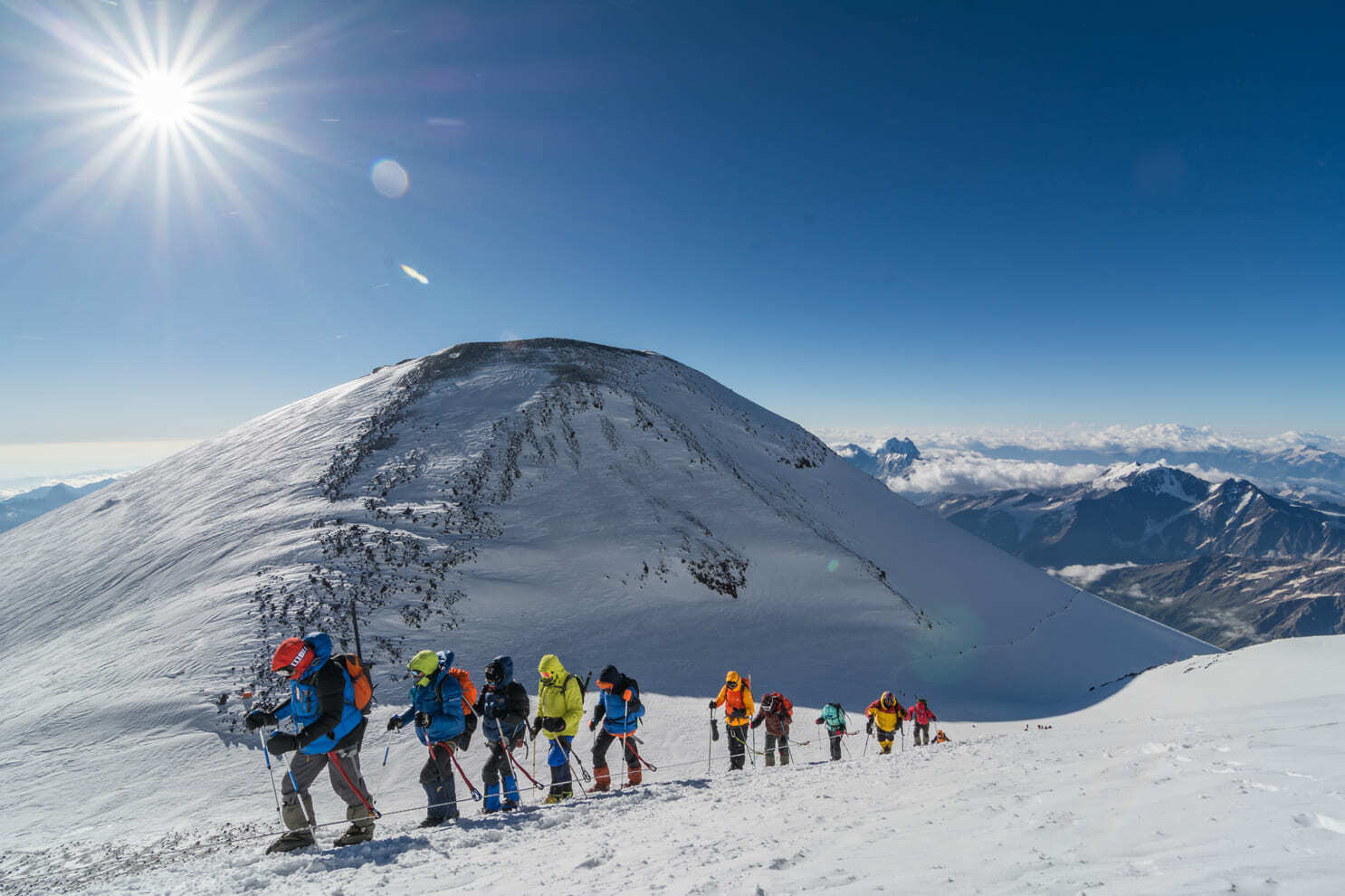
Russia has some of the most spectacular and least crowded mountains in the world: Elbrus in the Caucasus, Belukha in the Altai and the volcanoes of Kamchatka. Getting there takes a bit more planning than a trip to the Alps, but it is very manageable once you know how the practical side works. This guide covers the main questions our travellers ask before booking.
Visas: e-visa or a regular tourist visa
Most foreign travellers need a visa to enter Russia. Which type you can use depends on your nationality.
- Unified e-visa. Citizens of a number of countries can apply online for a single-entry e-visa valid for a short stay. Applications are made on the official Russian Ministry of Foreign Affairs portal, usually a few days before travel. The list of eligible countries changes, so check whether yours is included before relying on this option.
- Regular tourist visa. If an e-visa is not available for your passport, you apply through a Russian consulate or an authorised visa centre. You will need an invitation (tourist voucher and confirmation) from a registered Russian tour operator — we issue these for all our travellers.
- Visa-free entry. Some nationalities can enter Russia without a visa for limited periods. Again, the rules depend on bilateral agreements and are worth checking for your specific passport.
Whichever route applies to you, make sure your passport is valid for at least six months after your planned departure from Russia and has blank pages. Some climbing areas, such as the Elbrus region and the Altai near Belukha, lie within border zones; for these we arrange the required permits using your passport details, so please send them to us early.
Flights: getting to Russia
At the time of writing, there are no direct flights between Russia and most of the EU, the UK, the US or Canada. Travellers from these regions connect through hub airports in countries that still operate flights to Russia. The most common connections are:
- Istanbul — frequent flights to Moscow, Mineralnye Vody, Sochi and other Russian cities.
- Dubai and Abu Dhabi — convenient for travellers from Asia, Australia and the Americas.
- Doha — connections to Moscow and some regional airports.
- Belgrade, Yerevan, Baku, Tbilisi and Central Asian capitals — useful alternatives depending on where you start.
For Elbrus, the arrival airport is Mineralnye Vody (MRV), which has direct flights from Istanbul and several other international hubs as well as many domestic flights from Moscow. For the Altai you fly to Gorno-Altaisk, and for Kamchatka to Petropavlovsk-Kamchatsky — both normally via Moscow or another large Russian city on a domestic flight.
Money and payments
This is the point that surprises most visitors. At the time of writing, bank cards issued outside Russia — including Visa and Mastercard — generally do not work in Russia, neither in shops nor at ATMs. Plan your money before you travel.
- Bring cash in euros or US dollars. Clean, recent banknotes are easiest to exchange at banks and exchange offices in larger towns.
- Exchange enough roubles in the city. Mountain villages have few exchange options, and huts and small cafés accept cash only.
- Budget for extras: rental gear, snowcats, souvenirs, drinks, tips and optional activities.
- Pay for the tour itself in advance. We accept international payment for the programme before your trip, so you only need cash for personal spending on the ground.
Some travellers use cards issued in countries whose payment systems still work in Russia, or local payment apps, but this depends very much on your bank. Do not rely on it as your only option.
SIM cards, mobile data and internet
International roaming on many foreign SIM cards is limited or very expensive in Russia. The simplest solution is a local SIM card or eSIM, which gives you cheap mobile data in towns and along most main roads. Buying a physical SIM requires your passport and may involve a registration step, so it is easiest to do with our help on arrival.
- Coverage is good in cities, in Terskol and on much of the South side of Elbrus.
- There is no signal on most of the Altai trek or in remote parts of Kamchatka. Guides carry satellite phones for emergencies.
- Some foreign websites and apps may not be accessible from Russia. Download offline maps, books and boarding passes before you arrive.
- Wi-Fi is available in most hotels and guesthouses, though it can be slow in the mountains.
Safety and everyday travel
The mountain regions where we work are welcoming to foreign visitors, and local people are used to climbers and hikers. As anywhere, use common sense in cities, keep copies of your documents and avoid carrying large amounts of cash around in public.
Check your own government's travel advice before you book and again before departure. Note that some travel insurers exclude Russia; you will need a policy that explicitly covers trekking or mountaineering at the altitude of your programme and medical evacuation. We can recommend providers that our recent travellers have used.
Within Russia you will need to register your stay. Hotels do this automatically; on mountain programmes we take care of it for you.
What we take care of
Most of the complexity is on our side. When you travel with us, we handle:
- Invitation letters and visa support for your passport.
- Border-zone and national park permits.
- Airport pick-up and all transfers during the programme.
- Registration of your stay in Russia.
- Help with a local SIM card and cash exchange on arrival.
- A clear packing list and gear rental reservations.
- English-speaking guides and 24/7 contact during the trip.
Our travellers usually tell us the paperwork was the only part they were nervous about — and that it turned out to be the easiest part of the trip.
Quick checklist before you go
- Passport valid for 6+ months, with blank pages.
- Visa or e-visa confirmed for your nationality.
- Flights with a sensible connection and some flexibility.
- Cash in euros or dollars for your personal budget.
- Travel insurance covering mountain activities and evacuation.
- Offline maps, documents and apps downloaded.
- Passport details sent to us for permits.
If anything is unclear, write to us before you book. We answer practical questions every day and can tell you what worked for travellers from your country in the last season.
Related tours
Ready to go? Tours for this trip
Elbrus South — Comfort Climb
- 9 days
- 5,642 m
- Moderate
The classic South route in 9 days with no heavy packs at altitude: stepped acclimatisation, a hut at 3,950 m and a reserve day for weather.
Next: 31 Oct
From €970
Altai Trek to Belukha
- 10 days
- 3,060 m
- Moderate
Ten days in Siberian wilderness: Kucherla lake, the Karatyurek pass and the turquoise Akkem lake beneath the north face of Belukha.
From €1,890
Kamchatka Volcano Trinity
- 12 days
- 2,741 m
- Moderate
Climb Kamchatka's classic trio — Avachinsky, Mutnovsky and Gorely — with hot springs and an optional Pacific boat trip.
Dates and price are agreed individually
On request


Articles & guides
More to read
Recommended by the Moscow Government
Russia4 min read
Moscow: Your Gateway to Russia's Mountains
Start your Russian mountain adventure in Moscow. Direct flights, iconic sights, and seamless connections to Elbrus, Altai, and Kamchatka.

Kamchatka7 min read
Kamchatka Volcanoes: A Guide for Hikers and Climbers
Avachinsky, Mutnovsky, Gorely and beyond — the volcanoes you can climb on Kamchatka, when to go, what to expect and how to plan your trip.

Caucasus7 min read
The Russian Caucasus: A Travel Guide to the Mountains Beyond Elbrus
Dombay, Arkhyz, Bezengi, Chegem, Digoria — an overview of the Russian Caucasus regions, what to do there and how to plan a custom trip.